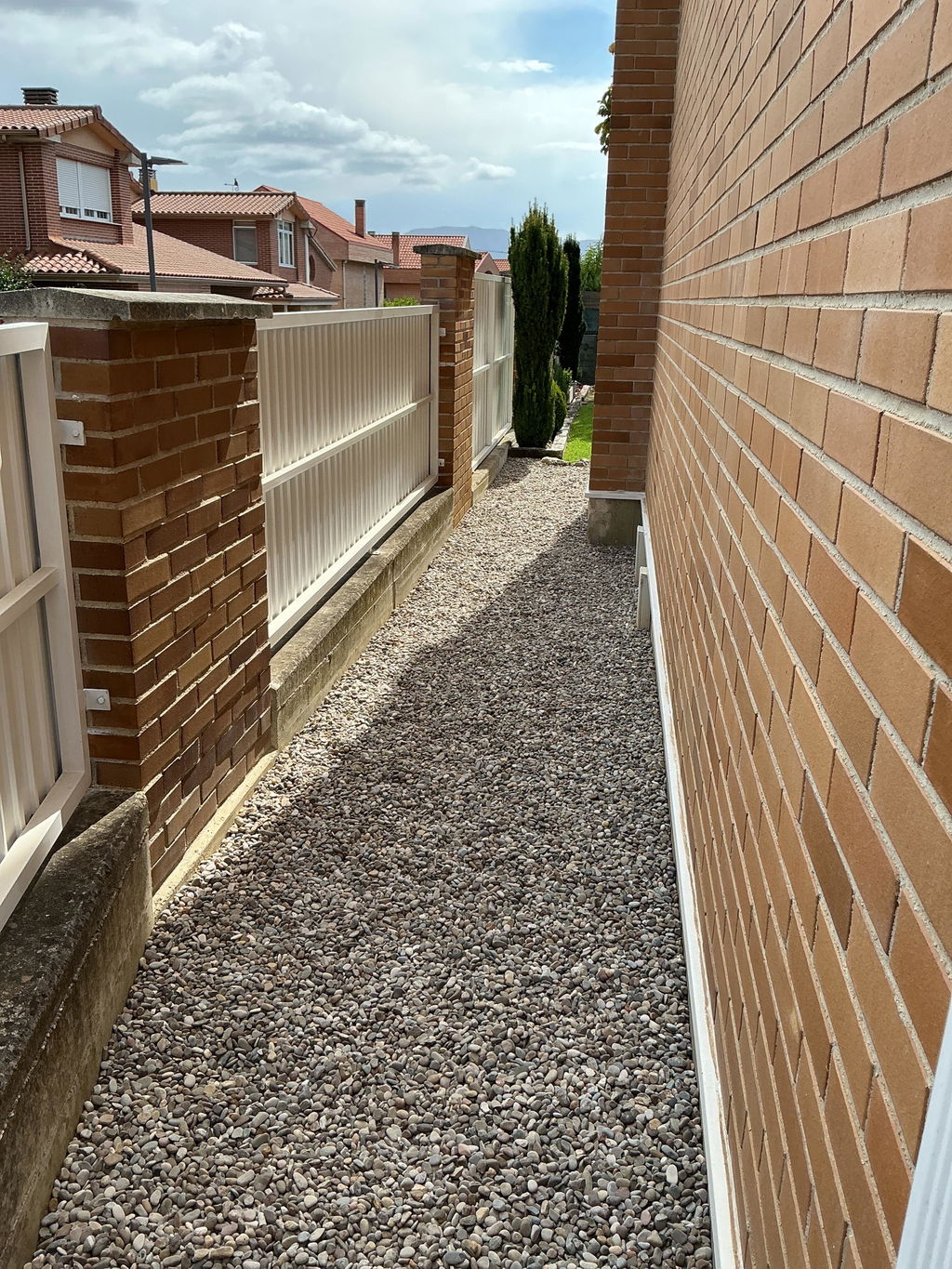
Perfect for a table-and-chairs area, giving you a hard, comfortable, attractive surface that also drains well.
If you're tired of dust, water and mud at your front door, Jabre can be your solution if you don't want to spend a lot of money. There are options like concreting, but it's very expensive, requires construction work, looks very artificial, requires building permits, and a long list of other drawbacks.
Do it yourself: a durable, affordable solution.
Sauló, or Jabre — it's called something different in every region — is decomposed granite with a grain size of 0-5 mm. It's a 100% natural material with some very useful properties for creating paths, walkways or seating areas in your garden.
With jabre we can create a surface that produces no dust when dry and no mud when wet. It has draining properties so water doesn't pool, giving you an area that stays comfortable and walkable in any season.
Laying jabre or sauló
Laying it is very simple; you can do it yourself with a bit of work, or hire a local handyman — you don't need a specialist unless you want a perfect finish, though of course a professional is a professional.
You need a layer 7 or 8 cm thick; spread the material and compact it — with mechanical equipment if you have it, or a metal tamper is enough; if you don't have a tamper, with a bit of imagination you're sure to find something to gradually compact the ground.
Once compacted, water the area and compact again.
The result is a porous surface — there will always be a thin layer of loose gravel on top — but it makes a comfortable, attractive, natural surface, good enough for areas with light vehicle traffic.
Other uses for jabre
Jabre has become very popular recently for natural pavements, tree pits, paths, trails and sports areas such as petanque courts.
Vehicle traffic
If the area where you want to use it sees continuous vehicle traffic, a good option is to mix the jabre or sauló with Stabex, a lime-based hydraulic binder — also a 100% natural product — that gives it much greater strength and durability while keeping it porous.
Big bag of Jabre or Sauló
We supply it in a 1,000 kg big bag. You'll need about 95 kg per m² (at 6 cm thickness), meaning each big bag covers around 10 m² — bear in mind if your ground has dips or irregularities you may need more.
Jabre for installing artificial grass
Jabre is a perfect product to lay under artificial grass: it forms a compact, porous base, which is exactly what artificial grass needs.
¡Un servicio excelente! Personal muy amable, atento y profesional. Desde el primer momento te hacen sentir muy bien atendido y se nota que realmente se preocupan por la satisfacción del cliente. Una experiencia fantástica y totalmente recomendable. ¡Muchas gracias por la excelente atención!