


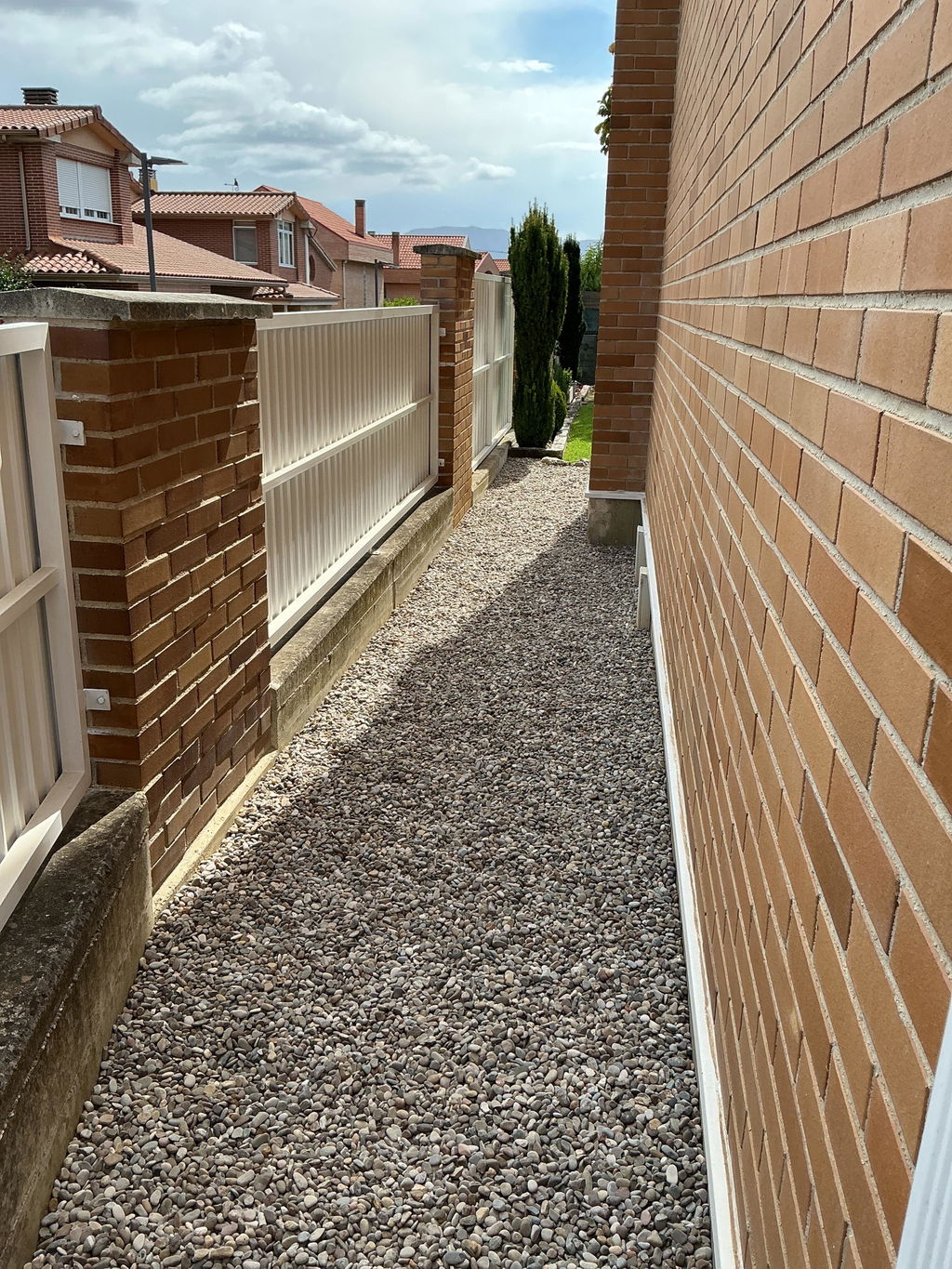
Todo perfecto. Facilidad para hacer el pedido, envío rápido y justo lo que buscábamos en cuanto a tamaño, color y calidad.
How much stone do I need?
How much stone do I need for the ground?
For pebbles and gravel:
• ±80 kg per m², based on a 5 cm layer.*For grain sizes >32 mm a thicker layer is required.• Consumption per big bag: 1000 kg = 0.625 m³.
• Coverage: ±12.5 m² with a 5 cm layer.
For pine bark:
• ±70 L per m², based on a 5 cm layer.
• Consumption per big bag: 1000 L = ±1 m³ = ±600 kg
• Coverage: ±14 m² with a 5 cm layer.
For volcanic rock, slate and chamotte:
• ±50 kg per m², based on a 5 cm layer.
• Consumption per big bag: 1000 kg = ±1 m³
• Coverage: ±20 m² with a 5 cm layer
How much stone do I need to fill a gabion?
Density of ±1,650 kg per m³.
The calculation is easy to understand with an example: for a gabion measuring 100x50x30 cm, do the following:
1x0.5x0.3 = 0.15 m³
0.15x1,650 = 247.50 kg of stone.
*It is always a good idea to allow 5% extra, as gabions widen slightly when filled and always take a little more stone than the theoretical calculation.
Please note!
PLEASE NOTE! Before buying, read this information about gravel and pebbles
Grain sizes are sieve sizes, not exact measurements
When we talk about stone of, for example, 60-80 mm, we mean that the stones pass through an 80x80 mm square mesh and do not pass through a 60x60 mm one. A stone 100 mm long and 65 mm wide can easily pass through that 80x80 mesh, because the mesh sorts by the width of the stone as it passes through, not by its total length. That is why it is normal for a percentage of stones to have some dimension above 80 mm or below 60 mm.
Machines do not sort 100% accurately
In addition, no industrial sorting process is perfect: there is always a small percentage of stone which, due to speed, irregular shape or pieces overlapping on the belt, does not pass correctly through the corresponding mesh and slips into the grade, so stones larger than stated may occasionally appear. This is normal for this type of product and is not considered a defect.
Breakage of pebbles
In pebbles over 60 mm, up to 10% of the stones may break during sorting, washing, loading and unloading. We currently have no machinery that completely prevents this breakage. The product photos show only real pieces: broken pieces have not been removed.
Dust and sand in the product
This product is not washed, so it contains dust, sand and even traces of other materials from processing and transport. This is no problem for its use: the stone washes itself over time, or you can rinse it with water before use if you prefer.
Colour can vary considerably between batches
This is natural stone, and the colour changes from one batch to another, sometimes noticeably. This is especially important for multi-toned stones such as Blanco Rosa: some batches come out very white and others very pink, within the same product. If the exact shade is very important for your project, we recommend not buying this type of product online, as we cannot guarantee that the batch you receive will match the photo or a previous purchase.
Returns
Please bear in mind that returns, especially of 1,000 kg big bags, are usually complicated and expensive because of the weight and volume of the material. If the return is not due to an error on our part, the costs and arrangement of the return transport are borne by the customer.
Chamotte Pebble
Chamotte Pebble - 100% Recycled
Discover our chamotte pebble, a 100% recycled product that combines aesthetics and functionality.
Main Features:
- Natural Decoration: Perfect for beautifying areas with plants and trees.
- Maintains Moisture: Preserves soil moisture, protecting your plants from excessive heat.
- Aesthetic Appeal: Its intense orange color when wet and soft when dry enhances the beauty of your plants.
- New Variety: Product launched at the end of 2020, innovative and original.
Advantages of Chamotte Pebble:
- Retains soil moisture up to 5 times more than normal gravel.
- Its striking color adds a unique decorative touch.
- Ideal for drainage, preventing root rot.
- Protects your plants from cold and direct rain.
Ecological Commitment:
This recycled pebble is made from brick rubble, contributing to waste reduction and helping the environment. By using our pebble, you not only beautify your green space but also contribute to sustainability.
⚠️ Important Notice about Porous Materials
Please note that crushed brick is a porous material. If installed in an area with poor drainage or where water stagnates, the natural phenomenon of Efflorescence (white stains) may occur.
-
What is it? They are mineral salts that water extracts from the material itself or from the soil. When the water evaporates, the salts become visible on the surface as white powder.
-
Solution: This residue is removed over time with rain or can be easily removed with an acid descaling cleaner. It is not a defect of the product, but a natural reaction to constant moisture.
Frequently asked questions about gravel, pebbles and decorative stone
How much gravel or pebbles do I need per square metre?
For gravel and pebbles you need approximately 80 kg per m² with a 5 cm thick layer. A 1,000 kg big bag (0.625 m³) covers about 12.5 m² at that thickness. For slate, volcanic rock or chamotte the amount is lower, around 50 kg per m² (20 m² per 1,000 kg big bag).
How thick should the gravel layer be?
For decorative use a layer of about 5 cm is recommended. With grain sizes above 32 mm it is advisable to increase the thickness slightly so that the stone covers the surface well.
Is a geotextile membrane needed before laying gravel?
Yes, it is recommended to lay a geotextile (weed control) membrane before spreading gravel or pebbles. It prevents the stone from mixing with the soil and reduces weed growth.
Why are some stones larger or smaller than the stated grain size?
The grain size (e.g. 60-80 mm) indicates the sieve size the stone passes through, not an exact measurement. A stone 100 mm long can still pass through an 80 mm mesh if its width allows, and no sorting process is 100% perfect, so it is normal to find some percentage of stone outside the stated range.
Is it normal for some pebbles to arrive broken?
Yes. In pebbles over 60 mm, up to 10% of the stones may break during sorting, washing, loading or transport. It is not a defect: the photos show real pieces, with broken ones not removed.
Are the gravel and pebbles washed?
No, the product may contain dust, sand or residues from the extraction and transport process. It does not affect its use: over time (rain, watering) it cleans itself, or you can wash it yourself before laying it.
Is the colour of the stone always exactly the same?
No. As it is natural stone, the colour can vary from one batch to another, especially in mixed-tone stones. If the exact shade is important for your project, we do not recommend buying without seeing it first, as we cannot guarantee it will match the photo.
How much stone do I need to fill a gabion?
The average density is about 1,650 kg per m³. For example, for a 100x50x30 cm gabion (0.15 m³) you will need approximately 247 kg of stone. It is advisable to allow 5% extra, as a little more stone than calculated usually fits when filling.