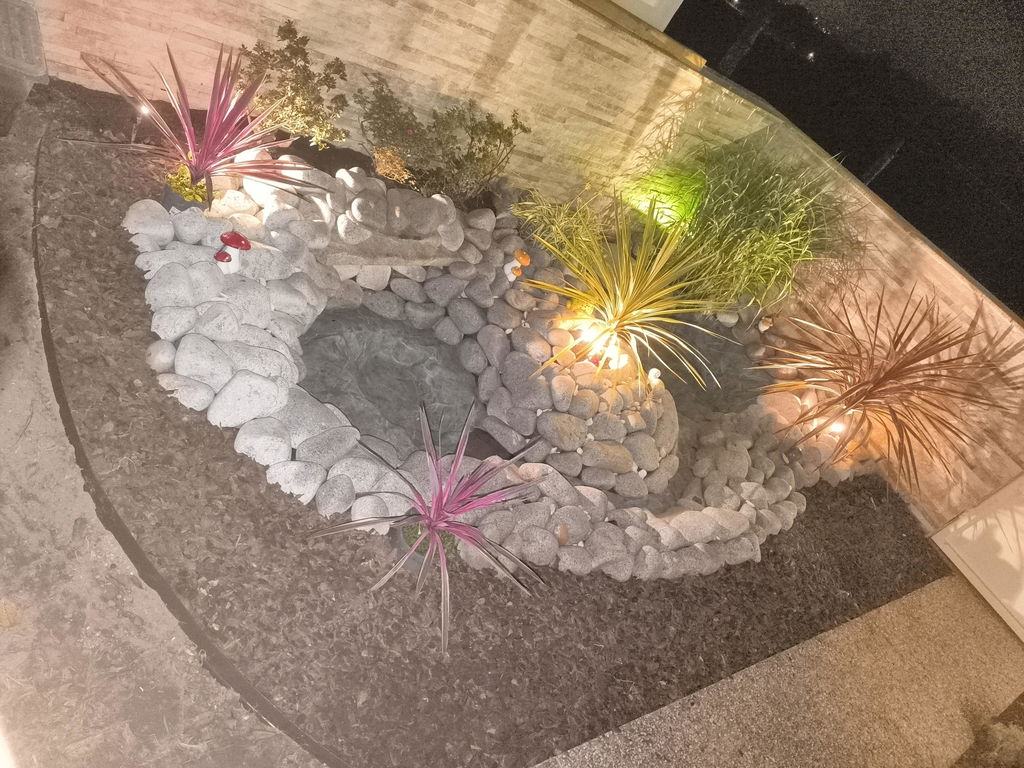
Excelente producto para impermeabilizar una fisura en la tela asfáltica.
Pebble Black Slate
7,61 €
7,61 €
Delivery in 3–9 days
Tax included.
Shipping calculated at checkout.
How much stone do I need?
How much stone do I need for the ground?
For pebbles and gravel:
• ±80 kg per m², based on a 5 cm layer.*For grain sizes >32 mm a thicker layer is required.• Consumption per big bag: 1000 kg = 0.625 m³.
• Coverage: ±12.5 m² with a 5 cm layer.
For pine bark:
• ±70 L per m², based on a 5 cm layer.
• Consumption per big bag: 1000 L = ±1 m³ = ±600 kg
• Coverage: ±14 m² with a 5 cm layer.
For volcanic rock, slate and chamotte:
• ±50 kg per m², based on a 5 cm layer.
• Consumption per big bag: 1000 kg = ±1 m³
• Coverage: ±20 m² with a 5 cm layer
How much stone do I need to fill a gabion?
Density of ±1,650 kg per m³.
The calculation is easy to understand with an example: for a gabion measuring 100x50x30 cm, do the following:
1x0.5x0.3 = 0.15 m³
0.15x1,650 = 247.50 kg of stone.
*It is always a good idea to allow 5% extra, as gabions widen slightly when filled and always take a little more stone than the theoretical calculation.
Please note!
PLEASE NOTE! Before buying, read this information about gravel and pebbles
Grain sizes are sieve sizes, not exact measurements
When we talk about stone of, for example, 60-80 mm, we mean that the stones pass through an 80x80 mm square mesh and do not pass through a 60x60 mm one. A stone 100 mm long and 65 mm wide can easily pass through that 80x80 mesh, because the mesh sorts by the width of the stone as it passes through, not by its total length. That is why it is normal for a percentage of stones to have some dimension above 80 mm or below 60 mm.
Machines do not sort 100% accurately
In addition, no industrial sorting process is perfect: there is always a small percentage of stone which, due to speed, irregular shape or pieces overlapping on the belt, does not pass correctly through the corresponding mesh and slips into the grade, so stones larger than stated may occasionally appear. This is normal for this type of product and is not considered a defect.
Breakage of pebbles
In pebbles over 60 mm, up to 10% of the stones may break during sorting, washing, loading and unloading. We currently have no machinery that completely prevents this breakage. The product photos show only real pieces: broken pieces have not been removed.
Dust and sand in the product
This product is not washed, so it contains dust, sand and even traces of other materials from processing and transport. This is no problem for its use: the stone washes itself over time, or you can rinse it with water before use if you prefer.
Colour can vary considerably between batches
This is natural stone, and the colour changes from one batch to another, sometimes noticeably. This is especially important for multi-toned stones such as Blanco Rosa: some batches come out very white and others very pink, within the same product. If the exact shade is very important for your project, we recommend not buying this type of product online, as we cannot guarantee that the batch you receive will match the photo or a previous purchase.
Returns
Please bear in mind that returns, especially of 1,000 kg big bags, are usually complicated and expensive because of the weight and volume of the material. If the return is not due to an error on our part, the costs and arrangement of the return transport are borne by the customer.
Pebble Black Slate
Black Laja River Pebble
Laja River Pebble in a black or very dark gray tone with white veining and flat, slate-like fracture shapes, an exclusive Vetonek product.
Make your contemporary project stand out with a stone that brings strength and elegance. When wet, the river pebble shows a very intense black color, while when dry it turns more gray, but it still catches the eye with the white veins running through each stone.
Make every piece a small, inimitable work of art, ideal for outdoor and indoor applications, giving any space a distinctive, modern touch.
Frequently asked questions
What does the Black Laja river pebble look like?
It is black or very dark gray in tone, with white veining and flat, slate-like fracture shapes.
Does it change color when wet?
Yes. When wet it shows a very intense black color and when dry it turns more gray, but it still catches the eye with its white veins.
Can it be used indoors and outdoors?
Yes, according to its description it is ideal for both outdoor and indoor applications.
What style of project is it suitable for?
It is recommended for contemporary projects, where it brings strength, elegance and a distinctive, modern touch.
Frequently asked questions about gravel, pebbles and decorative stone
¿Qué es la fractura en laja?
Formas planas naturales de la piedra que, junto a su veta blanca sobre fondo negro, dan un acabado muy escultural.
¿Cambia de color?
Sí: negro intenso en mojado y gris oscuro en seco, siempre con las vetas blancas destacando.
¿Qué medidas hay?
De 12-24 mm hasta 60-120 mm, esta última ideal para gaviones y rocallas.
¿Cuánta cantidad necesito por metro cuadrado?
Calcula unos 80 kg por m² para una capa de 5 cm: un saco de 20 kg cubre aproximadamente 0,25 m² y un big bag de 1.000 kg, unos 12,5 m². En granulometrías gruesas conviene una capa algo mayor.
¿Qué granulometría elijo?
Hay 4 medidas: 12-24 mm, 24-40 mm, 40-60 mm, 60-120 mm. Para zonas de paso y estabilizadores de grava elige la más fina; las medias decoran parterres y alcorques, y las gruesas son puramente decorativas o para gaviones, no para pisar.
¿En qué formatos se vende?
En Saco 20 kg, Big bag 1.000 kg. El transporte te deja el palet o big bag en la puerta de casa.
¿Hace falta malla antihierbas debajo?
Sí, muy recomendable: una malla o geotextil antihierbas bajo la piedra evita que salgan malas hierbas y facilita el mantenimiento durante años.